During Second World War, the need of fast displacements, originating from of the hard lessons apprehended by the allies through Blitzkrieg, it forced to the development of an entire philosophy of self-propelled artillery. The Americans were well served in this field, with some reliable and robust vehicles. It can be mentioned, as the most characteristic of them, M7 Priest , that carried an 105mm howitzer. This GMC (Gun Motor Carriage) it was the spine of the American Self-propelling Artillery. This vehicle was based on M3 Lee's chassis.

With the unfolding of the Conflict, the need of larger weapons, of larger calibers, took to the development of M12, also based on M3 Lee's chassis, only that carrying a gun of larger caliber: M1917, derived of the French cannons of First World War. GMC M12 increased a larger weight to the American self-propelling barrage.
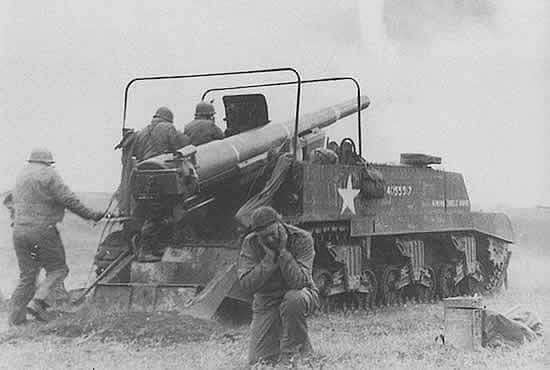
But the M12 it carried a weapon of First World War, the stocks of these guns went lowering quickly, for the intense and necessary use. The American Army opted for the change of this obsolete weapon for a more modern cannon, of larger reach and reliability, although of same caliber. M1 155mm Long Tom:

M3 Lee's chassis no longer it presented load capacity to absorb the weight and the energies liberated by Long Tom's shot. To avoid development complications, it was chosen Sherman M4 reliable chassis, in your more recent version, M4A3E8, with horizontal volute springs suspension (HVSS), known like Easy-Eight.

Easy-eight was derived of the sub-type (E8) and for the displacement softness, thanks to this new suspension and to a larger distribution of weight of the vehicle to the soil, in reason of the tracks be much wider than the one of the previous series M4 and M3.
The created vehicle of these modifications was a natural evolution of M12, although totally different in your conception.

Initially designated like T83 Gun Motor Carrier, your construction began in March, 1944, when 5 vehicle-pilots were built, with the tests demonstrating the success of the concept and of the design, with a perfect marriage between the gun and the chassis. T83 was accepted to enter in production in February of 1945, and in May of 1945 your designation was altered of T83 for M40. Just one vehicle T83 was sent to the battlefield of Europe, participating in the Zebra Mission, close to Colony, Germany, in March, 1945. This vehicle showed a characteristic camouflage of black stripes on standard Olive-drab of the Americans.

With the success of T83, an armed version with the M1/M2 8 inches (203mm) howitzer was proposed and built, being known as T89. 576 units were ordered, but with the end of the war, with only 48 built units, the request was canceled. T89 was renamed M43 in November,1945. Like the T83, only one T89 see action in WW II.

Besides the 8 inches howitzer version of the M40, as in the case of M12, a ammunition carrier version, T30 was build. The T30 had no gun and was adapted a ring for .50 machine gun , similar to used in armored-car M20.

Technical specifications - M40 (T83) GMC 155mm:
Engine: Continental R-975 C4, gasoline, 9 cilinders, radial , 15900 cc, 400 HPs at 2400 rpm.
Chassis: Prolonged M4A3E8 and enlarged.
Crew: 8 (commandant, driver and 6 gunners)
Maximum speed: 38 km/h
Capacity of fuel: 976 l
Autonomy: 160 kms
Dimensions: Length with the gun: 8.822 mm x Width 3.150 mm x height with gun 3.300 mm
Armament: M1A1/M2 gun of 155mm Long Tom in a support M13
Load capacity: 20 projectiles of 155mm
Reach of the cannon: 23 kms
Weight: 37 tons
Production: )






 M40 (T83) GMC 155mm - AFV Club - 1/35 scale - Zebra Mission


 I must say I don't know anything about this gun when I first saw this kit in the LHS a month or two ago. The background history in your post really helps to explain about it and you've got me interested.


 Linear Mode


